Most startup stories that get glorified are dramatic.
“We almost ran out of money.” “We had to pivot.” “It nearly failed.”
Ours didn’t really have moments like that. It was mostly a long stretch of building, talking to users, fixing things, and trying not to make decisions that would put us out of business.
A lot of startup advice is about growing at all costs, raising money, setting ambitious targets, moving quickly and figuring things out later.
It all sounds reasonable. It just didn’t feel like something we could follow without taking risks we couldn’t afford.
So, we kept things simple: no bets we couldn’t afford to lose, no growth at all costs, no unrealistic targets.
That ruled out a surprising number of “normal” startup decisions. It’s what kept us alive and thriving for seven years.
- Sustaining the startup beats breakout growth
- It’s okay to stay self-funded
- It’s okay to keep things small
- Charging from day one simplified things
- Organic growth beats manufactured growth
- It’s slower, and that’s the trade-off
- Most of it is just the “boring” work
- Seven years later, it adds up
- You don’t need to chase the dramatic story
Sustaining the startup beats breakout growth
A lot of startup advice pushes you to take bigger risks, faster moves, higher stakes. That works sometimes. But if your goal is to still be around in a few years, avoiding certain situations helps.
We avoided bets where the downside was losing the company. We didn’t spend money we didn’t have. We didn’t set targets that forced us into risky decisions just to hit them.
Instead, we started out with our own pocket money, built something people would find useful, let them use the tool, provide feedback, stick around and bring more people.
The focus was on the things that would help the business survive.
It’s okay to stay self-funded
It’s okay to self-fund if you can, and if the nature of your business allows it. We’re 100% user-supported to this day and a good breakdown of how we did that is here.
We have deliberately turned down hundreds of investing offers. Staying self-supported forced us to not postpone figuring out how the business works. There was no runway to fall back on, no buffer to absorb bad decisions.
If something didn’t work, we felt it immediately.
That forces a certain kind of clarity. You don’t build features “just in case.” You don’t chase ideas that might pay off later. You focus on what works now and improve from there. That makes you keep things simple, even if you don’t realize it while it’s happening.
It also removes a layer of pressure.
We didn’t have to grow at a specific pace or work toward a predefined outcome. We just had to make something people would pay for and keep using.
That decision simplifies a lot of things. If customers are the ones funding the business, the product has to be useful. There’s no fallback.
That kind of independence is hard to give up.
Being open source is part of what makes it credible. The code is public. People can see exactly what the product does with their data. You don’t have to take our word for it.
It’s okay to keep things small
We’re still a core team of 10 folks. We didn’t hire fast. We didn’t build a big team to feel like we’re growing while the real metrics (like profit, number of users, goodwill, etc.) would reflect otherwise.
We didn’t take on costs assuming future growth would cover them. Partly because we couldn’t. Partly because we didn’t want to.
That constraint ended up being useful.
When you don’t have much room, you focus on what actually matters. You cut scope more aggressively. You don’t add complexity unless you really need it. You ship smaller improvements instead of big, risky changes.
It also changes how you think about risk.
When it’s your own business, not a runway from investors, big bets feel different. You start avoiding the kind of decisions that could wipe you out.
So instead of trying to jump ahead, we just kept things manageable and kept going.
Charging from day one simplified things
We chose a subscription model from the start.
In a market where most people default to Google Analytics 4, that’s not the obvious move, scary even. But it simplified things for us.
We’re not trying to match every feature or collect as much data as possible. We’re not trying to lock people in.
If someone is paying, the product has to make sense quickly. There’s no room for confusion or unnecessary complexity.
So we kept it simple. Focused on the core use case. Avoided building features we didn’t really believe in.
We just built something simpler. Something you can understand quickly. And something that respects user privacy by default.
Over time, it became clear why someone would pay for a simpler, privacy-friendly alternative instead of sticking with free.
We also didn’t need a second business model. No ads, no selling data, no trade-offs hidden behind “free.”
Just a product people pay for because it’s useful.
Organic growth beats manufactured growth
We didn’t run ads. We didn’t build aggressive funnels. We didn’t define a narrow Ideal Customer Profile and optimize everything around it.
We also avoided a lot of the usual tactics that come with that approach.
No retargeting. No tracking people across the web. No popups or intrusive calls to action. No email sequences trying to “nurture” people into paying. No sales calls.
That wasn’t some grand strategy. It just didn’t feel like how we wanted to build. Most of our growth came despite not doing these things.
Instead, people found us through content, trying the product, and telling others.
That’s it.
It’s slower. There’s no obvious spike you can point to.
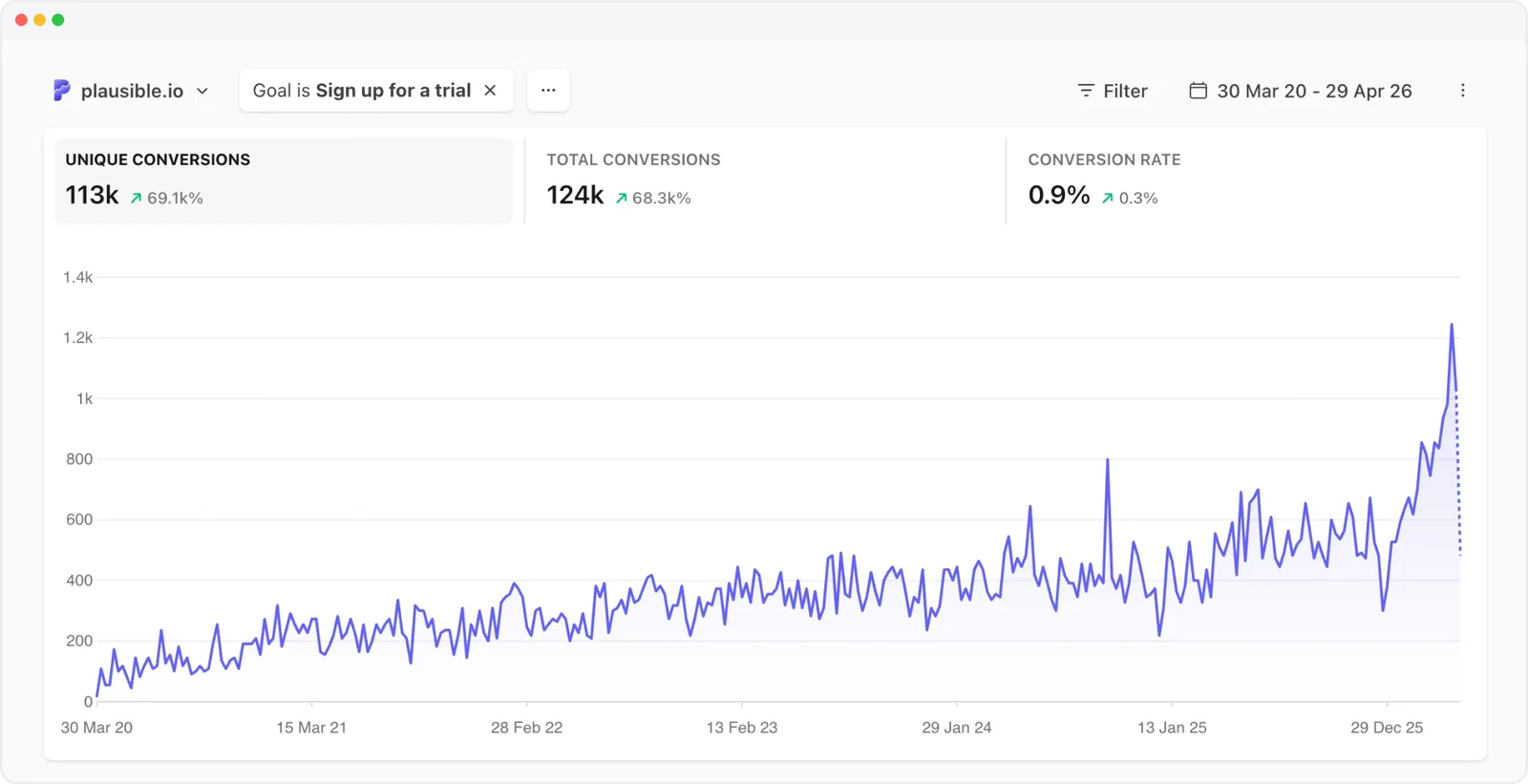
It took us 324 days to reach the first $400 MRR. Took us 3 years to make $1M ARR. And another 3 to multiply it several times over. And we were profitable within the first few years.
But it’s simpler, it sticks, and the compounding tends to outlast anything you could manufacture.
It’s slower, and that’s the trade-off
This approach isn’t faster.
You grow more slowly. You get less attention. There are long stretches where it feels like not much is happening, especially when other companies are moving quicker.
We felt that too.
But the upside is you don’t have to make decisions just to keep up. You don’t have to take risks that don’t make sense for your situation.
You just keep going.
Tortoise does beat the hare.
Most of it is just the “boring” work
There’s this idea that building a startup is a series of intense, high-stakes moments. In our case, it might not be as true. Most weeks look the same:
Work on the product. Work on the communication. Fix something that’s broken or confusing. Talk to users. Ship an improvement.
Do that again next week.
It’s not exciting. It doesn’t give you that “we’re onto something big” feeling all the time. But it keeps things moving and sometimes gives great results too.
Seven years later, it adds up
Seven years is a long time to keep doing something. That’s probably the real outlier.
Not a big pivot or a lucky break. Just continuing long enough for the small things to compound.
We’re still here. We’re profitable. We’re independent.
No big moment got us here. It was just consistency and not making decisions we’d regret later.
And we still enjoy working on it.
You don’t need to chase the dramatic story
This isn’t the only way to do things.
Some companies raise money, move fast, take big risks, and build something huge. That works for some. This is what worked for us.
Build something useful. Charge for it. Keep your costs under control. Improve it steadily.
Give it time.
It won’t make for the most glamorous story. But you might still be here in seven years.
Survival matters more than it gets credit for. Profitability gives you options. Independence keeps things simpler. And if you still enjoy the work after a few years, that’s a very underrated win.
